GameWatch: AI keeps the peace in a game built on lies

We first released Deceit into Early Access in 2016, long before social deduction was a tag on Steam. Ten years and more than 20 million downloads later, one thing has become very clear: a game like ours lives or dies on voice chat.
Unlike many social deduction games, Deceit 2 is built around matchmaking. You are dropped into a match with strangers in voice chat, and accusations can become heated very quickly.
With tens of thousands of daily active users, our game moderators have never been able to review every match. So, following advancements in AI technology, in 2024 we built GameWatch.
GameWatch is our automated voice-moderation system that runs within our own backend. It transcribes and analyses player voice chat, supports human moderation decisions, and can respond to player reports during a live match — including temporarily muting abusive players while the game is still in progress.
The pipeline operates asynchronously and separately from the game loop, so it does not introduce additional latency into a match. GameWatch operates in two main ways.
Acting on player reports in realtime
When one player reports another during a Deceit 2 match, GameWatch can analyse the relevant moment and take immediate action. Where the system detects sufficiently serious abuse, it can mute the reported player during the same match.
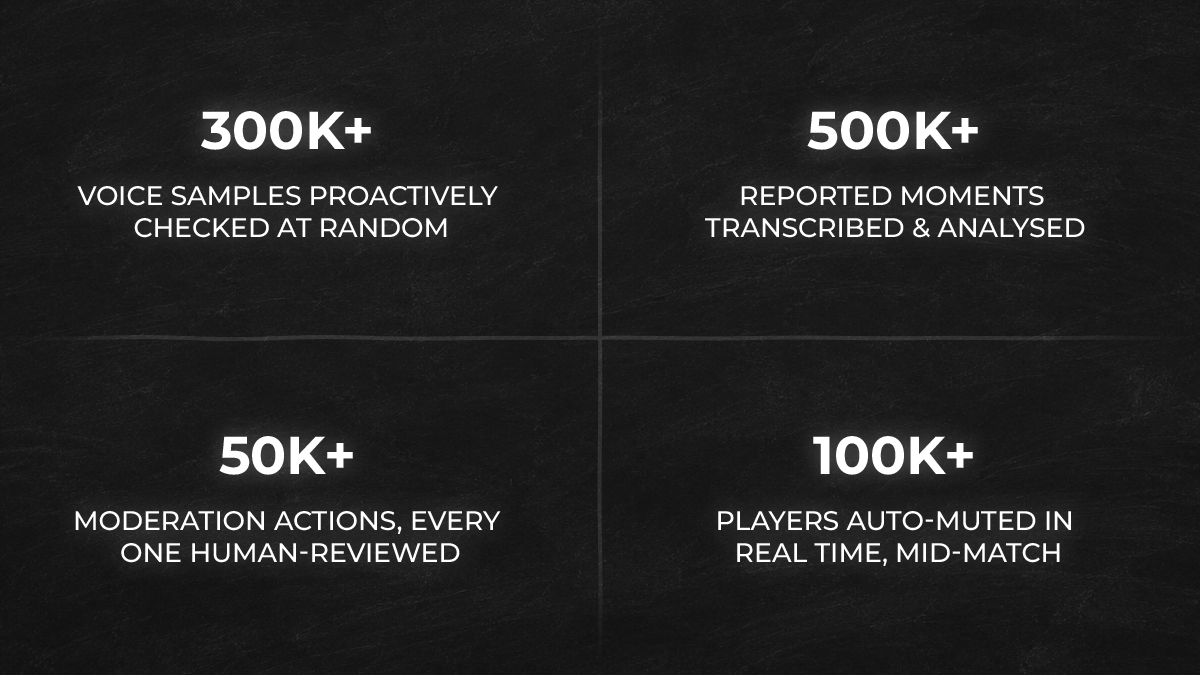
That immediate response is one of the parts players notice most. To date, GameWatch has generated over 100,000 automated in-game mutes from 500,000 reported voice moments that were transcribed and analysed.
These interventions are temporary. Any lasting moderation outcome is reviewed by a member of our team.
Deploying cost-effective AI inference
Sending every minute of every voice conversation to a managed transcription service would be straightforward to build, but it would create a significant and open-ended recurring cost. It would also mean processing large amounts of audio that would never contribute to a moderation decision.
We approached managing the cost of GameWatch in three main ways:
GameWatch keeps its workload bounded. Reports from players are processed on demand, and proactive monitoring uses limited random sampling. As a result, we can choose to scale up or down the total cost of the system based on the proportion of games we sample.
Transcription is quantized and run on CPUs. Whilst models continue to improve in performance every few months, as of 2026 we still see significant premiums attached to GPU pricing, thus leveraging CPU burst compute with quantized models remains highly cost-effective.
A separate text-analysis stage produces risk signals. Keeping transcription and moderation decisions as distinct services allows each part of the pipeline to scale independently.
The principles behind GameWatch
A few principles guided us while building the system:
Humans decide lasting outcomes. GameWatch handles transcription, analysis and immediate protective actions, but permanent moderation decisions are reviewed by a real person. Our team has reviewed more than 50,000 moderation cases so far. There are no fully automated bans.
Privacy is built into the process. Transcription takes place on infrastructure we control. Audio and transcripts that do not require further review are not retained beyond the needs of the moderation process, while moderators are only shown the information necessary to assess an incident.
The intervention threshold is deliberately high. Deceit 2 is a game about suspicion, accusation and deception. Bluffing strangers is part of the experience. We designed GameWatch to distinguish heated gameplay from behaviour that genuinely crosses the line.
Building GameWatch has taught us an enormous amount about the real-world trade-offs in deploying AI models into live games. In doing so, we can now moderate sooner, give players more confidence in reports, and make voice chat safer without removing the tension and unpredictability that define Deceit.
— World Makers Team